For small laundry room organization, empty the room, keep only what you use, then set it up in the order laundry moves: sort, wash, dry, fold, hang. Put rolling bins for dirty clothes by the washer, a folding surface by the dryer and a hanging bar after it, and store detergent up high in its original container.
Before moving the machines or adding a counter, try the Small Laundry Room Layout Planner. Enter the appliance footprints, installation allowances and loading space, then check whether the places you sort and fold remain reachable.
1. Empty it and sort what’s there
Take everything off the shelves and out of the cabinets, and sort it into groups:
- Washing: detergent, packets, fabric softener, bleach, stain removers
- Drying: dryer sheets or balls, the drying rack, clothespins
- Ironing and mending: the iron, the board, a sewing kit
- Cleaning: anything stored here that isn’t for laundry
- Lost and found: odd socks, pocket finds
Keep partly used products in their original labeled containers, and follow each label when disposing of empty packaging. Move anything that isn’t laundry to where it’s used. What’s left is what needs a place.
2. Set up the room in the order laundry moves
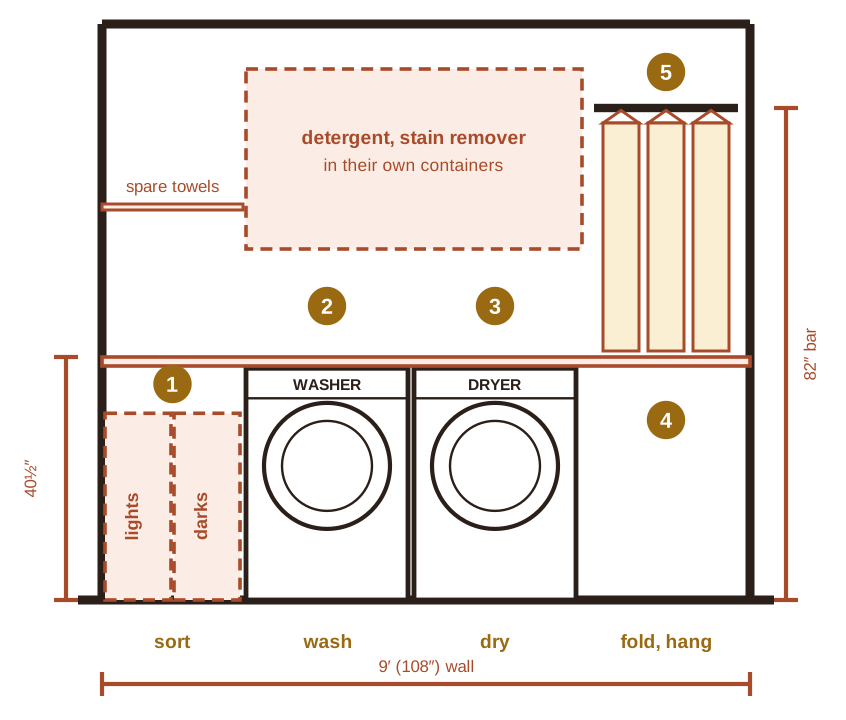
Laundry goes one way: from the hamper to the washer, to the dryer, to a surface for folding, to hangers. Line the room up the same way, so nothing crosses back:
In a room too small for every zone, the top of the dryer or a counter over front-loaders does the folding, and the back of the door does the hanging. Our small laundry room ideas show what fits around the machines.
3. Sort dirty clothes into bins as they come in
Sorting at the start saves sorting a pile on the floor later. Two or three bins cover most homes: lights, darks, and towels or bedding. Bins that roll can go to the bedroom and back:
- IKEA’s ENHET laundry bin is 11″ wide, 21¾ deep and 31⅛ tall, holds 21 gallons and rolls on casters: slim enough for the gap beside a washer or under a counter.
- A JÄLL laundry bag on a stand is 16½×17″ and 23½ tall, and holds 13 gallons.
4. Store detergent up high, in its own container
Decanting detergent into matching jars looks tidy, but the American Cleaning Institute advises against it:
- Keep cleaning products in their original containers, with the label on, so the instructions and safety information stay with them.
- Store liquid laundry packets in their original container, up and out of sight and reach of children. ACI calls storing them in clear containers a dangerous trend.
- Put products away right after use, and fit child safety locks on the cabinets if young children live or visit there.
So detergent and stain removers go in a cabinet or on a high shelf above the machines, not on the counter. Wall cabinets usually hang about 18 inches above a counter: over a 40½-inch counter on front-loaders, that’s about 58½ inches. If anyone swallows a cleaning product, call Poison Control at 1-800-222-1222.
5. Give folding a surface
Clothes wrinkle while they wait in the dryer for a free surface. Options, from best to smallest:
- A counter over front-loaders: use the exact appliance’s dimension guide and installed height to set the counter underside and surrounding allowances. Whirlpool’s WFW6620HC guide distinguishes recommended spacing from required ventilation openings; its dimensions should not be copied to other machines. Plan independent counter support and appliance removal for servicing.
- The top of the dryer, kept clear of everything else.
- A cart or a drop-down shelf beside the machines, if the room has a spare wall.
A fixed counter cannot cross a top-loader’s lid-opening path. Check the exact model’s full lid movement and open-lid height before placing a shelf, bracket or folding surface nearby. Whirlpool’s general sizing advice is a starting reminder, not a substitute for that model’s instructions.
6. Hang clothes as soon as the dryer stops
A bar right after the dryer saves ironing. IKEA’s MULIG clothes bar adjusts from 23⅝ to 35⅜″ wide and holds 33 pounds. Shirts hang 38 to 42 inches long, so mount the bar high enough for them to clear what’s below: over a 40½-inch counter, about 82 inches up, or on a bare wall, about 66 inches, the height of a single closet rod. Keep a few hangers on the bar so they’re there when the load comes out.
7. Give the small things a home
- A lint bin by the dryer. Empty the lint filter after every load: the U.S. Fire Administration reports that failure to clean was the leading factor (31%) in home clothes dryer fires from 2018 to 2020.
- A stain kit by the washer, so stains are treated before the wash, and a printed laundry symbols chart inside a cabinet door.
- A lost-sock basket. Match them at the end of the month and give up on the rest.
- A small mending kit for buttons that come off in the wash.
Keep it that way
A laundry room stays organized when the bins go back empty and the products go back up. Each week, wipe the machine tops and the counter. Every few months, clear behind and around the dryer and check the vent. And plug both machines straight into a wall outlet: the Fire Administration says never to run a washer or dryer on an extension cord.
Questions about small laundry room organization
How do I organize my laundry room?
Empty it, keep only what you use, and set it up in the order laundry moves: bins for sorting, the washer, the dryer, a folding surface, a hanging bar. Store detergent up high in its original container, and give lint, stains and odd socks their own small homes.
Where should laundry detergent be stored?
Up high, in a cabinet or on a shelf children can’t reach, in its original container with the label. The American Cleaning Institute says to keep laundry packets up and out of sight and reach of children, and not to move them into clear containers.
How do you organize a small laundry room with no cabinets?
Use the wall above the machines for open shelves or a wall cabinet, the gaps beside them for an 11-inch rolling bin or a slim cart, and the back of the door for a hanging bar or hooks. Keep detergent on the highest shelf.
What should be in a laundry room?
Bins for dirty clothes, detergent and stain remover, a folding surface, a hanging bar with hangers, a drying rack, a lint bin, and, if there’s room, the iron and ironing board.
How often should you clean the lint filter?
After every load. Failure to clean was the leading factor in home clothes dryer fires from 2018 to 2020, at 31%, according to the U.S. Fire Administration.
Final Takeaway
Set the room up in the order laundry moves, keep detergent up high in its original container and give the small things a home. The room stays organized when the bins go back empty, the products go back up and the lint filter is emptied after every load.
Set your room and openings, place the washer and dryer side by side or stacked, open their doors, and check the loading space and the route before you move anything.
More small laundry room guides: Plan a small laundry room · Stacked or side by side · Small laundry closets · Walk-through laundry rooms · Small laundry room storage ideas
Main Sources
- Packets Up! and Cleaning product safety (American Cleaning Institute): laundry packets in their original containers, up and out of sight and reach of children; clear containers a dangerous trend; products in original containers with labels; put products away after use; child safety locks; Poison Control 1-800-222-1222
- Appliance and electrical fire safety (U.S. Fire Administration): plug washers and dryers directly into a wall outlet, never an extension cord; failure to clean was the leading factor (31%) in home clothes dryer fires, 2018–2020
- Washer and Dryer Dimensions (Whirlpool): general appliance-sizing guidance; verify the actual open-lid height in the selected model’s instructions; and the WFW6620HC dimension guide: model-specific dimensions, recommended spacing and required enclosure ventilation openings
- Laundry baskets and drying racks (IKEA US): product pages for the ENHET laundry bin, JÄLL laundry bag with stand and MULIG clothes bar
- What Are Standard Kitchen Cabinet Sizes? (KraftMaid): wall cabinets typically installed 54″ above the floor, or 18″ above the countertop