Start with a lamp on furniture you already need, or a suitable wall or clamp light, before adding another floor base. Measure the widest shade, the arm in use and the cord route too. A fixture saves space only when people can still pass, stand up and use the table comfortably.
A small living room can need better light without having room for another lamp stand. Start at the seat where you read, the table where you work or the entrance you use after dark. Then find a place for the light that preserves the furniture and walking space already working well.
The useful measurement is rarely just the lamp’s base. A wide shade can overhang a narrow table; a wall light can swing into your shoulder; a neat-looking cord can cross the only route out. Check these parts separately before choosing the fixture.
Choose the light around the space you already have
Mark the usual seats, doors, television and outlets on a simple plan. For each seat that needs light, look first at existing furniture and the wall beside it. Buying another side table purely to support a lamp can use more floor than a compact floor lamp would.
| Option | Where it can save space | Check before choosing it |
|---|---|---|
| Table lamp | Uses a side table already needed for drinks or books | Base, shade overhang and usable tabletop left |
| Wall reading light | Removes a separate floor base | Full projection, swing, fixings and power route |
| Clamp light | Uses a suitable shelf or table edge | Permitted clamp range, support strength and moving arm |
| Compact floor lamp | Occupies an otherwise unused pocket beside seating | Feet or base, shade width and access to its switch |
| Existing ceiling light | Adds no furniture footprint | Whether the seated activity still needs local light |
If the sofa or television position is still unsettled, begin with the small living room layout guides. Settle the main furniture before buying lights to fill the gaps around it.
Measure the base and the projection separately
One lamp, 14 fewer inches
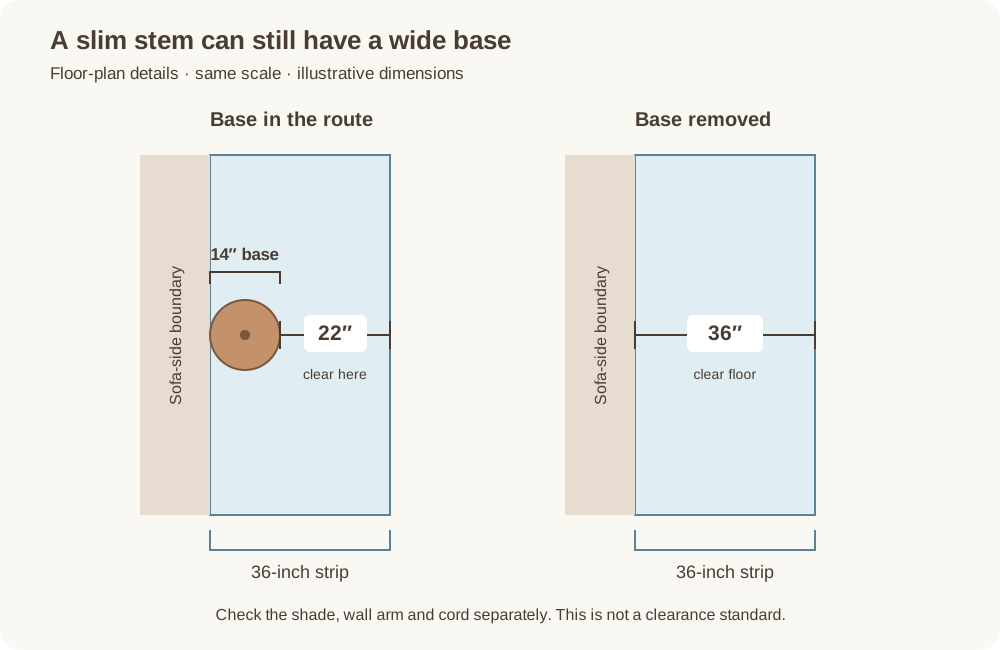
Consider a selected 36-inch-wide strip beside a sofa. A hypothetical circular lamp base, 14 inches across, stands entirely within that strip with one edge at the sofa-side boundary. At its widest point, the base leaves 36 − 14 = 22 inches of clear floor.
That remaining gap must suit the people using it. Removing the lamp base restores the full strip at this point, but replacing it with a low projecting wall light could leave a shoulder-level obstruction. Walk through the proposed arrangement with the actual users and any mobility equipment.
Use the Small Living Room Layout Planner to compare your main furniture positions and measured gaps. Check lamp projections and cords separately on the room sketch; a clear furniture plan does not establish that every accessory fits.
A small base can carry a wide shade
Suppose a 20-inch-square side table holds a lamp with a 6-inch base and a centered 16-inch shade. The base leaves 7 inches to each table edge; the shade’s outline leaves only 2 inches. Those are different measurements at different heights, not interchangeable amounts of usable space.
Place a cup and the book you normally use on the table. Check that you can reach them without touching the shade or cord. Also stand from the sofa: a shade that clears the tabletop can still occupy the space your head or shoulder uses.
Use wall and clamp lights where their arms can work
A wall light saves the floor occupied by its base, but it is not necessarily shallow. For example, IKEA’s RANARP wall/clamp spotlight lists a 13-inch depth and a clamping range up to 1¼ inches. These are dimensions for that model, not a recommendation for every small room.
Check the light in its working position and any position it can swing into. A movable arm above a side table may stay outside the route; the same arm beside a doorway may project into passing space. Include cupboard doors, curtains and the movement of a reclining chair in this check.
For a clamp fixture, follow the manufacturer’s permitted mounting arrangements and check the surface thickness and support. A shelf that fits the clamp is not automatically strong or stable enough for the light. For a wall fixture, use suitable fixings and follow the installation instructions; a plug-in cord does not remove the mounting requirement.
In a rental, check the terms before drilling. A table lamp on furniture already in place may be the simpler choice. Avoid improvising an adhesive mounting method unless the manufacturer explicitly allows it.
Keep the useful position connected to a suitable outlet
Draw the complete cord route before committing to a lamp position. Include the distance down a wall or table leg and around furniture, rather than drawing a straight line through the sofa. Keep the plug and controls accessible without moving heavy furniture.
The Electrical Safety Foundation’s cord guidance warns against cords in high-traffic areas or under rugs and furniture. It also describes extension cords as temporary solutions. Hiding a cord under a rug does not make a narrow passage work.
Check that furniture will not pinch the cable and that a moving chair cannot catch it. Follow the fixture’s routing instructions. If the useful position needs a new outlet or fixed wiring, have a qualified electrician assess it. A permanent lighting arrangement should not depend on an extension cord across the doorway.
Test the light from the seat, then test the route
Try the arrangement after dark with the room’s usual activities. Read in the chair, use the side table and watch the television from each regular seat. Move or aim the light if your head shadows the page or an exposed bulb sits in your normal view.
Check reflections with the television on and off. A light beside one person can appear in the screen from another seat. If the screen itself needs a better position, use the small living room TV layouts before squeezing the lamp into an awkward corner.
For bulb comparisons, the FTC’s guide to buying light bulbs distinguishes brightness in lumens from energy use in watts. Color appearance is a separate choice. Follow the fixture’s bulb limits and check compatibility before using a dimmer; a brighter bulb cannot fix a shade that blocks the route.
Finally, walk in carrying laundry, stand up with a book and reach the switch. A lightweight cardboard outline can help you check a proposed shade before buying. Repeat the test with doors open and chairs in use, not only with the room tidied for a photograph.
Common questions
Are wall lights always better in a small living room?
No. They remove a floor base but still project into the room and need suitable mounting and power. Compare the complete fixture with a lamp on an existing table.
Can a floor lamp go behind the sofa?
Sometimes, if its base and shade fit, it remains stable and the cord and switch stay accessible. Do not create a new obstruction in a passage behind the sofa.
How many lamps does a small living room need?
There is no useful count based on size alone. Identify the activities lacking light, test a suitable fixture there and retain enough general light to move around comfortably.
Final Takeaway
Choose lighting that uses space already available around your seats. Measure the base, shade, moving arm and cord separately, then test the arrangement while someone uses the room. Saving a patch of floor matters most when the light and the walking route both work.
Set your room, doors and windows, add a TV, sectional, fireplace, piano or dining table, and check the walking route before you move anything.
More small living room guides: All small living room layouts · Layouts with a TV · Layouts with a sectional · Layouts with a fireplace · Layouts with a front door · Layouts with a piano · Toy storage without losing seating space · A dining table in a small living room · A living room and dining room in one
Main Sources
- IKEA: RANARP wall/clamp spotlight — model dimensions and clamp range.
- Electrical Safety Foundation: cord placement and extension-cord use — avoid traffic areas, rugs, pinching and permanent extension-cord arrangements.
- Federal Trade Commission: Shopping for Light Bulbs: What to Look for — brightness, energy use and the Lighting Facts label.