Start with the toys that need to stay in the living room, then fit their storage around the seats and routes you use every day. Measure each container inside its unit and while being removed. A cabinet that fits when closed can still block the room when someone opens it.
Toy storage in a small living room has two jobs: give toys a home and leave the room usable for everyone else. One cabinet with accessible boxes can work better than several baskets that migrate between the sofa, the doorway and the floor.
Start with the seats you want to keep. Mark the route to each seat and through the room, then look for storage outside those paths. If the seating arrangement itself needs work, compare the small living room layouts before buying another piece of furniture.
Decide what belongs in the living room
Sort toys by how they are used here. Books for reading on the sofa, a favorite building set and a few pretend-play items may need daily access. Larger sets used elsewhere do not automatically need permanent living-room storage because there is an empty corner.
Try the containers before choosing a cabinet. Fill a box with one group and check whether its intended user can lift it, see the contents and put it back. A deep bin holds plenty, but the bottom may be difficult to reach. Smaller groups can be easier to carry without tipping everything onto the floor.
If rotation suits your household, keep an active selection nearby and store the rest in an agreed place elsewhere. Reserve room for unfinished play, too: a shallow project tray can hold a partly built model without claiming an entire sofa cushion. The tray needs a parking place once play ends.
Choose storage by how it opens
| Storage type | Useful for | What to measure |
|---|---|---|
| Bins in an existing unit | Daily toys without another cabinet | Internal opening, bin handles and removal path |
| Low unit with removable boxes | A selection children can reach | Unit depth, box movement and the user's position |
| Closed cabinet | Keeping toys out of sight between uses | Door swing, usable shelf depth and access controls |
| Storage ottoman | Combining storage with a footrest you already need | Full footprint, lid movement and where a top tray goes |
| Wall shelving | Items handled by an adult | Fixings, load limit and reach; avoid a climbing target |
Measure the inside separately from the outside. A cabinet sold as 16 inches deep does not necessarily accept a 16-inch-deep box. Its back, hinges and doors reduce useful depth. Check the narrowest opening as well as the shelf: a box can fit inside yet catch on a hinge during removal.
As a concrete size reference, IKEA lists this TROFAST combination at 39 inches wide, 17⅜ inches deep and 22 inches high. Those are outside dimensions. They exclude the floor needed to remove a box or sit in front of it; other combinations have different measurements. Use the assembled dimensions, not the packaging measurements farther down a product listing.
Count the floor used by a pulled-out bin
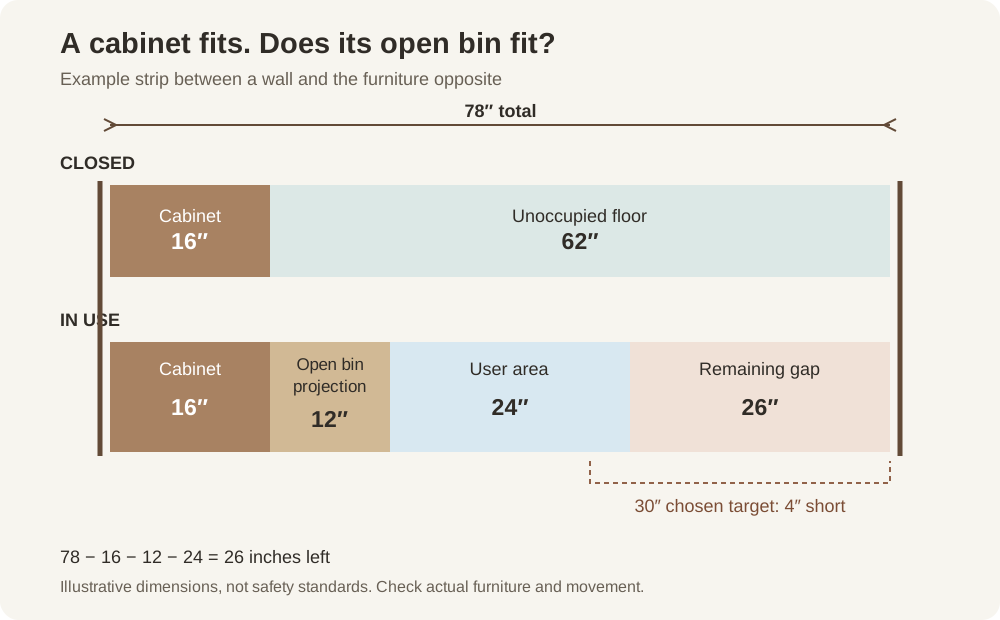
Suppose the measured strip between a wall and the furniture opposite is 78 inches deep. Consider a hypothetical cabinet 16 inches deep, a bin projecting another 12 inches when open and a 24-inch area for the person handling it. These are example assumptions, not the TROFAST dimensions above.
The remaining space is 78 − 16 − 12 − 24 = 26 inches. If you chose a 30-inch passing target for this particular spot, the open arrangement is 4 inches short. Closed, the cabinet leaves 62 inches. It can look comfortable in a photograph while making people wait whenever someone gets a toy.
Try turning the unit so it opens into a space outside the main route, or choose a smaller box that can be carried to the play area. A temporarily occupied alcove is different from the only way to the door. Do not solve the conflict by storing the pulled-out bin on a seat.
A shallower cabinet alone may not fix the problem if the same large container still needs to come out. Tape the full working area on the floor and have someone use it while another person passes. You may need more room than the example allows.
Use existing furniture before adding another piece
Look for a suitable shelf in an existing cabinet or space under a side table. Check that a container can move past the legs. At a media unit, keep toys away from accessible electronics, cables and ventilation openings. If the whole media wall needs rearranging, use the small living room TV plans to check seating and circulation first.
A storage ottoman earns its place when you already need a footrest. If storage is the only goal, a large central ottoman may take more useful floor than a wall unit. Draw the lid's movement and decide where a tray, books and drinks go when it opens. An ottoman sold for adults is not automatically suitable as a child's toy chest.
Under-sofa boxes are another option only when the actual frame permits them. Measure the lowest rail, feet and any center support, then check the extraction path. A box that slides out only after moving a heavy coffee table is unlikely to become part of an easy daily routine.
Make child access part of the furniture choice
Follow the manufacturer's anchoring instructions. CPSC's Anchor It guidance recommends securing furniture and televisions, and removing objects that tempt children to climb. A low-looking unit does not cancel its installation requirements. Keep an attractive toy off the top of a tall cabinet rather than relying on a verbal reminder not to climb.
Avoid repurposing a heavy-lidded trunk as a child's toy box. CPSC's storage and toy chest guidance identifies falling lids and entrapment hazards. For a child-accessible chest, look for a purpose-made product with a lid support that holds the lid open in every position, unobstructed ventilation and no automatic locking latch. A “soft-close” label alone does not address all of those hazards.
Keep older children's small toys away from younger children who could reach them. Decide which containers can be used independently and which need adult control. Picture labels can make an accessible selection easier to return, but they do not replace age suitability or safe access.
Test cleanup before buying more storage
Try the proposed number of containers in their intended locations for a few days. Notice what repeatedly stays out. It may need a wider box, a lower shelf or fewer pieces in the active selection. If a basket keeps landing on the sofa so someone can open a cabinet, change its location before adding matching baskets.
Use the living room planner to compare the main furniture positions, then check the bin, lid and user movements with a tape measure in the actual room. The planner does not assess toy safety or furniture anchoring. For other spaces, browse our storage and organization guides.
Common questions
Are baskets better than drawers in a small living room?
Neither always needs less space. Compare the basket's removal path with the drawer's open projection. A removable basket can travel to the play area; a drawer needs access in front of its unit.
How can I hide toys without a large cabinet?
Use suitable enclosed space in furniture you already need, or containers that fit its shelves. Match them to the internal opening and check that you can remove them easily.
Should all the toys be stored together?
Only if that helps everyone use and return them. Separating the daily living-room selection from larger or less-used sets can reduce the storage furniture needed here.
Final Takeaway
Useful toy storage needs capacity, an opening path and a place for its user. Keep the daily selection manageable, test cleanup and protect the seats and routes before adding another unit.
Set your room, doors and windows, add a TV, sectional, fireplace, piano or dining table, and check the walking route before you move anything.
Related guides: All small living room layouts · Layouts with a TV · Layouts with a sectional · Layouts with a fireplace · Layouts with a front door · Layouts with a piano · Lighting that saves floor space · A dining table in a small living room · A living room and dining room in one
Main Sources
- IKEA: TROFAST storage combination dimensions — outside dimensions for the specific combination used as a size reference.
- CPSC: Anchor It — furniture and television anchoring, and avoiding climbing temptations.
- CPSC: Dangers of storage and toy chests — lid support, ventilation and locking hazards; consumer guidance originally issued in 2014.