The most useful small bedroom storage ideas use space you don't walk on, then check the floor each one needs in use. In the 10 × 10 ft example, under-bed drawers need 48″ beside the bed for a 24″ drawer and you, more than the 28″ on each side of a centered queen. A tall 24 × 12″ unit and a wall shelf need 6 sq ft in use instead of 20, giving 14 sq ft back and both sides of the bed.
The most useful small bedroom storage ideas use space you don't walk on: under the bed, up the walls, inside the closet and on the back of the door. Each one still borrows floor when you use it, for an open drawer, a swinging door and you standing there. The nine places below are measured that way, with what each costs and what to test before you buy.
Most examples share one room, 10 × 10 ft with a 64 × 84-inch queen frame; its sizes and the space allowed for you are illustrative, not standards, so swap in your own. This guide covers where things can go; the guide to organizing a small bedroom covers sorting and keeping it tidy, and small bedroom ideas the wider layout.
To test a place at full scale, draw your room in the Small Bedroom Layout Planner. It places beds, a wardrobe and a dresser, keeps an editable zone in front of each storage piece for its doors or drawers, and checks the route to each bed.
1. Under the bed: drawers need floor beside it
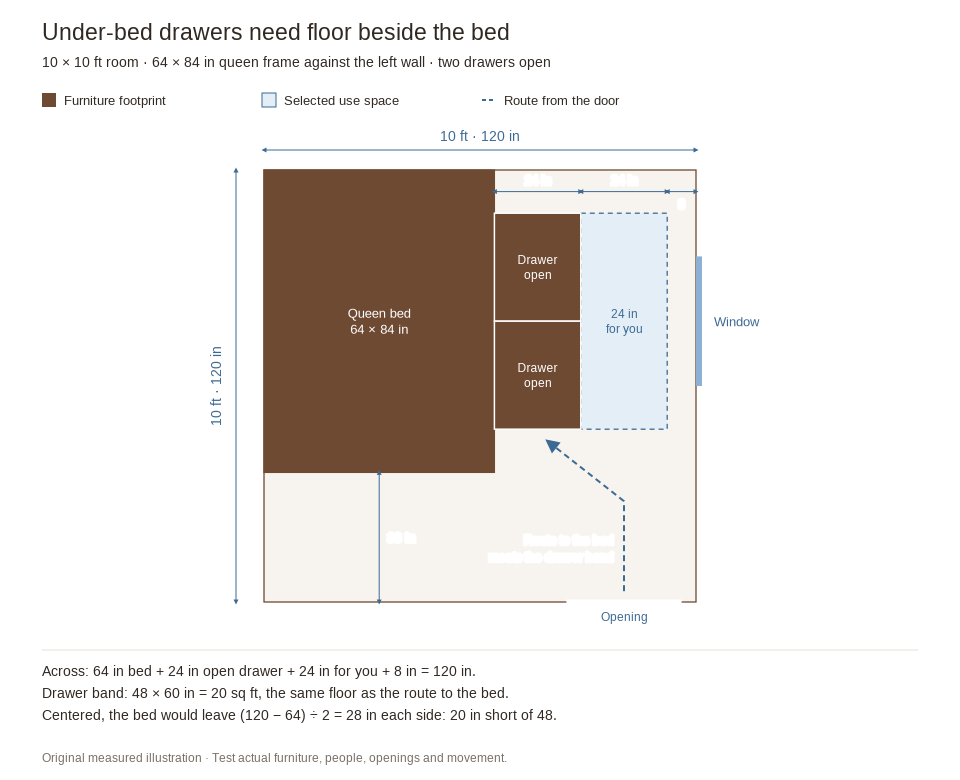
Under-bed drawers and rolling boxes fill otherwise empty space, but they open sideways into the room: each needs its own depth beside the bed, plus room for you to kneel in front of it. The first drawing allows 24 inches for an open drawer and 24 for you, 48 inches in all.
Centered, the queen frame would leave (120 − 64) ÷ 2 = 28 inches on each side, 20 short. So the bed moves against the left wall, leaving 120 − 64 = 56 inches on the right and giving up its wall side. Even then, the drawer band and the route to the bed share the same floor, which suits spare bedding far better than clothes you need every morning.
Check the height too: measure from the floor to the lowest part of the frame, such as a rail or center leg, and compare it with the box's full height on its casters. IKEA's VARDÖ under-bed box, for example, is 7⅛ inches high and 27½ deep, so it needs more than 7⅛ inches under the frame and 27½ + 24 = 51½ inches beside the bed.
2. A lift-up bed: storage you open from above
A lift-up, or ottoman, bed gives access to storage from above. It can avoid the floor strip needed by side drawers, but it still needs its full operating space: the moving base and mattress, clear access to the handle or strap, and room for you to lift, reach and close it. A bedside lamp, shelf or low ceiling can interfere with a raised platform even when the closed bed fits.
Ask to try the exact model with a compatible mattress fitted. Check its instructions for mattress size and weight, the lift sequence and any locking or support mechanism. For example, IKEA's MALM queen storage bed specifies a maximum mattress weight of 110 pounds; that is a limit for this product, not for all lift-up beds. Never assume an empty-frame demonstration tells you how your mattress-loaded bed will operate.
Then try retrieving the item you actually plan to keep there. Opening a lid is only the first job: a large suitcase must also pass through the opening, and you need somewhere to put it afterward. In a tight room, storage for occasional bedding may justify that routine more readily than clothes you need several times each day.
3. The closet: rods, shelves and doors
Measure the inside width and depth, and the longest things you hang, from the top of the hanger to the hem. Where most of your clothes are short, two rods, one above the other, hang two rows in the height of one; long coats and dresses need a full-height section. Shelves above the rod add room for lighter things. To plan a small closet rod by rod, with the heights for short and long clothes, see how to organize a small closet.
Then measure the doors. A hinged door sweeps its own width into the room, so two 24-inch doors need 24 inches clear in front of the closet as they open. Bifold doors fold back but still stand out into the room as they fold, so measure them open. Sliding doors take no floor, but only one half of the closet is open at a time.
4. Up the wall: shelves above the bed or desk
Wall shelves take no floor, which makes the space above a headboard or desk tempting. Fix them as their maker's instructions say for your type of wall, and if you rent, ask first. Then sit up against the headboard, or at the desk, have someone mark the wall above your head, and keep the shelf's underside well clear of the mark.
Keep what goes above a bed light. FEMA's earthquake home hazard advice includes securely fastening or moving heavy pictures and mirrors that hang over beds, and Ready.gov suggests storing heavy and breakable objects on low shelves. For a desk, the bedroom office combo guide measures it beside the bed.
5. Go tall and narrow instead of low and wide
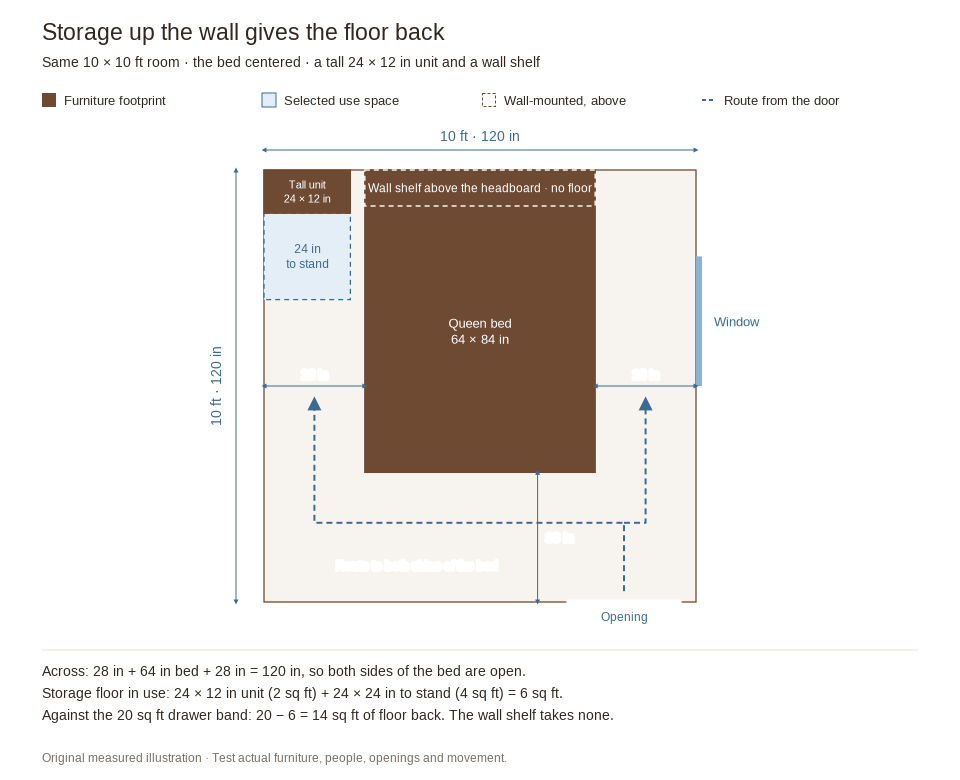
Height costs no extra floor; width and depth do. The second drawing keeps the same bed but centers it, with 28 inches on each side, and moves the storage up: a shelf on the wall above the headboard and a tall unit, 24 inches wide and 12 deep, in the corner beside the bed.
In use, the unit and its standing space take 2 + 4 = 6 sq ft against the drawers' 20, so 20 − 6 = 14 sq ft comes back and both sides of the bed open again, one for each person in a couple; the small master bedroom guide plans that room. Keep the top shelves, reached with a step stool, for things you rarely use.
A tall piece needs anchoring. The CPSC's Anchor It guidance says to secure furniture as the manufacturer instructs, and that existing furniture can be anchored with inexpensive anti-tip brackets. The CPSC also advises keeping heavier items on lower shelves and tempting things, such as toys, off higher ones, where children may climb for them.
6. A dresser: room for the drawers and for you
A dresser needs its depth, an open drawer and you: with an 18-inch-deep dresser, a 16-inch drawer and 24 inches to stand, that is 18 + 16 + 24 = 58 inches from the wall. The 36 inches at the foot of the bed in the 10 × 10 ft room can't take it, and a dresser there would block the route whenever a drawer opened. Look for a wall with 58 inches free, or a shallower chest measured the same way.
New dressers come with anti-tip devices, and the CPSC says to install them right away. A mandatory federal stability standard for dressers, armoires, wardrobes and other clothing storage units took effect on 1 September 2023, and the CPSC still recommends anchoring dressers to the wall. Its Anchor It campaign also says to store heavier items in lower drawers.
7. A storage headboard or a bench at the foot
Both combine storage with another function, but they still occupy floor. A projecting storage headboard or a separate bench extends the bed-and-storage footprint. In the 10 × 10 ft room, a 10-inch-deep bookcase headboard pushes the bed out and cuts the 36 inches at its foot to 26; a 16-inch-deep storage bench at the foot leaves 20. Tape the strip that is left and walk it before you buy. A bench lid has to open too, so keep the bedding off it.
8. The back of the door
Hooks and over-door racks use a surface you already have. With things hanging on them, check that the door still closes, opens fully and clears the bed and the dresser. Keep it easy to use as a way out: the U.S. Fire Administration advises finding two ways out of every room and making sure doors and windows are not blocked, which applies to a tall unit near the window as well.
9. No closet? A wardrobe, a rail and hooks
Without a closet, hanging space has to stand on the floor. A wardrobe hides it behind doors that need their swing plus room to stand; an open clothes rail needs no door space but shows everything. A wardrobe counts as a clothing storage unit under the CPSC's standard, so anchor it like a dresser. Add door hooks for tomorrow's clothes and under-bed boxes for the off-season. If two people share the room, give each a section of their own: the shared bedroom privacy and two beds in a small room guides plan storage for both.
Questions about small bedroom storage ideas
How do I maximize storage in a small bedroom?
Use the space you don't walk on first: under the bed, up the walls, the closet and the back of the door, then check each place in use. In the 10 × 10 ft example, under-bed drawers need 48 inches beside the bed; a tall 24 × 12-inch unit with room to stand needs 6 sq ft.
What bedroom storage solutions work best?
The ones that open into space you can spare. A lift-up bed can suit narrow bed sides if its raised platform and operating area stay clear, a tall narrow unit takes less floor than a low wide one, double rods suit a closet of short clothes, and wall shelves suit light things.
How do you store clothes without a closet?
Hang them in a freestanding wardrobe or on an open rail, fold the rest into a chest or a tall unit, and use door hooks and under-bed boxes for the overflow. Anchor the wardrobe and leave room for its doors to open.
Final Takeaway
Whichever small bedroom storage ideas you choose, put them where you don't walk, then measure each one in use: the piece, its open drawer or door, and you. Storage that goes up the wall takes less floor than storage that goes wide, as long as it is anchored, and drawers under the bed work only where the floor beside them can stay clear.
Set your room, door and window, add one to three beds, a bunk, a guest bed, a desk or a privacy screen, and check the route to each bed before you move anything.
Related guides: All layouts for small bedrooms · Small bedroom ideas · Two beds in a small room · Three beds in a small room · Awkward small bedrooms · Small guest bedrooms · A desk in a small bedroom · Privacy in a shared bedroom
Main Sources
- IKEA: MALM queen storage bed, article 704.048.18 — lift-up access and the model-specific mattress-weight limit; instructions are linked from the product page.
- IKEA: VARDÖ under-bed storage box — 25⅝ inches wide, 27½ deep and 7⅛ high, on casters, with a fabric lid.
- CPSC: Anchor It — securing furniture as the manufacturer instructs, anti-tip brackets for existing furniture, and installing the anti-tip devices sold with new dressers right away.
- CPSC: Anchor TVs and furniture (February 2026) — anchoring bookcases and dressers, heavier items on lower shelves and tempting items off higher ones.
- CPSC: final standard for clothing storage units (April 2023) — dressers, armoires, wardrobes and other clothing storage units, effective 1 September 2023, with anchoring still recommended.
- CPSC: Anchor It campaign launch (June 2015) — heavier items on lower shelves or in lower drawers.
- FEMA: Do Your Own Earthquake Home Hazard Hunt — securely fastening or moving heavy pictures and mirrors over beds.
- Ready.gov: Earthquakes — securing objects that hang on walls, and heavy and breakable objects on low shelves.
- U.S. Fire Administration: Home Fire Escape Plans — two ways out of every room, with doors and windows not blocked.
The room, furniture sizes, allowances and arithmetic in both drawings are original illustrative examples, not standards or product specifications. The drawn drawers are not VARDÖ dimensions: use your own box's figures.