To declutter a small apartment, start with one place you want to use again: the dining table, an armchair or the floor beside the bed. Sort only what fits on a small working surface, return the things you are keeping, and arrange a destination for what leaves. Finish that area before opening another cupboard.
The difficulty in a compact home is that sorting space is also living space. Emptying three cabinets onto the floor can leave you unable to cook, sit down or get to bed. A useful session ends with the apartment working better, even if plenty remains for another day.
Choose a result you can see and use
“Declutter the apartment” is too large to tell you where to begin. “Eat dinner at the table without moving anything” gives you a clear stopping point. Pick an everyday activity that belongings currently interrupt, then identify the small area responsible.
Start with objects whose next step is already obvious: packaging ready for the appropriate recycling collection, a borrowed item ready to return, or shoes that belong elsewhere. Leave shared belongings and someone else’s collection for a joint decision. You can clear your own stack without deciding the future of everything in the room.
Set aside time for putting things back as well as sorting. In a 30-minute session, for example, you might spend 20 minutes making decisions and reserve the final 10 for returning items and clearing the work surface. That split is a starting suggestion, not a finish-time promise. Stop taking things out when you reach the reset portion.
If the route through the room is the problem, first distinguish loose belongings from badly positioned furniture. Our guide to planning a small studio around daily routes handles the furniture arrangement; decluttering addresses the things accumulating around it.
Set up a sorting station that cannot spread
Use an existing table, counter or clear shelf, with a small amount of space for “stays here,” “belongs elsewhere” and “leaving.” Reuse containers you already own. Their job is to hold the current batch, not encourage you to pull out enough belongings to fill every bag in the apartment.
The example below uses a 48-by-24-inch table. Three 14-by-20-inch trays fit across it with two 2-inch gaps and a 1-inch margin at either end: 1 + 14 + 2 + 14 + 2 + 14 + 1 = 48 inches. If your surface is smaller, use fewer containers and make decisions in smaller batches.
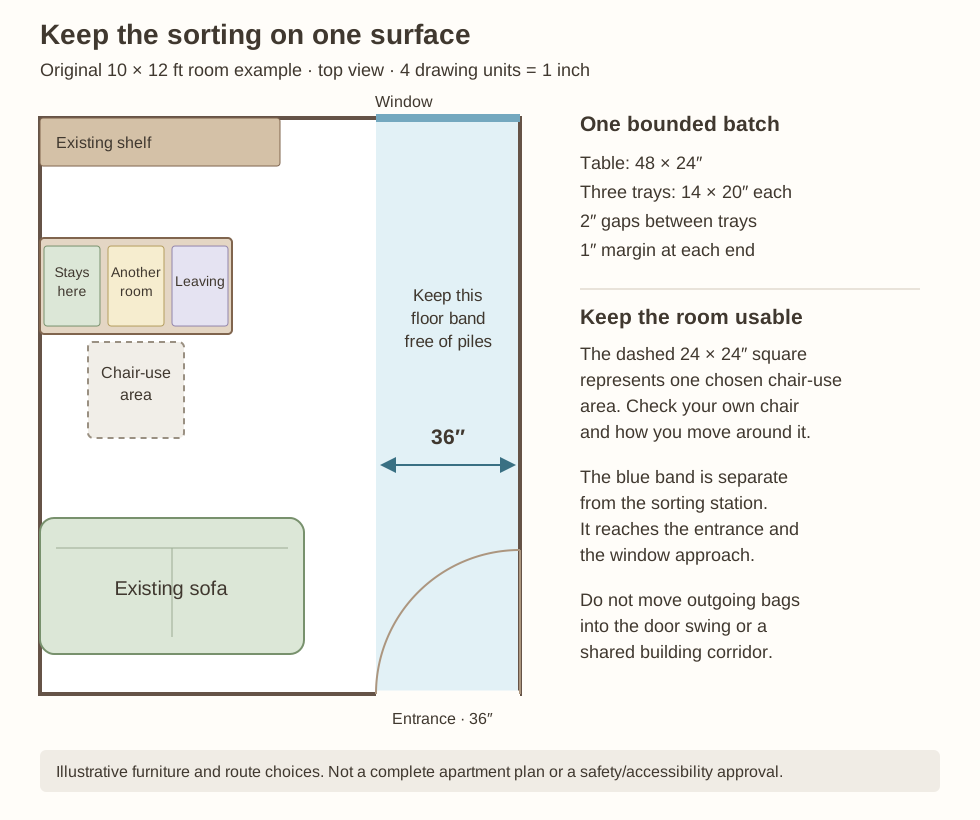
Do not use the bed as an overflow surface if you need it before the session ends. Keep bags out of door swings and shared corridors. The U.S. Fire Administration’s escape-planning guidance calls for unblocked doors and windows; temporary sorting piles still count as obstructions.
Keep the collection, reconsider its overflow
A valued collection does not automatically become clutter because it is large. The useful question is whether its allotted storage lets you put things away and retrieve them. Measure usable shelf width between the sides, excluding dividers, before buying another basket or cabinet.
In the original example below, a 30-inch shelf faces 35 inches of books. We choose a 4-inch spare section so the row is not packed tightly. Keeping 26 inches on this shelf leaves 9 inches of books to reassign or let go. That is a measurement of this allocation, not a rule about how many books anyone should own.
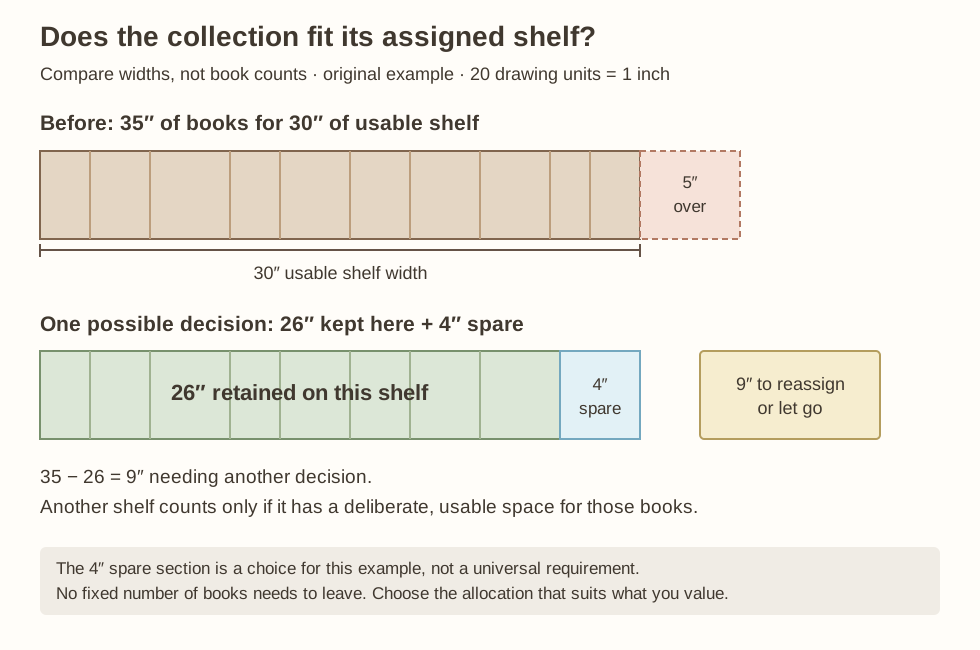
You might keep the favorites here and give another shelf to reference books. You might release books you no longer want. If every possible home is already full, something else must change: the quantity, the allocation or the furniture footprint. Do not count an unplanned floor stack as extra storage.
Watch a small collection decision in practice
In Grace Audrey Davis’s small-apartment decluttering video, the book section beginning around 4:56 shows a useful distinction: she values the collection but selects books she no longer wants for a book swap. Later, she explains that clearing some shelf space lets books previously left on the floor fit with the others. The apartment has not gained a new storage unit; an existing one has become easier to use.
Watch for that decision rather than treating the video’s two-hour session as a target. A small, completed shelf can be a worthwhile session on its own. The room and shelf dimensions in our diagrams are separate illustrative examples.
Video: Grace Audrey Davis — small-apartment decluttering, book section.
Give each decision a physical next step
A “maybe” pile can quietly occupy the space you hoped to recover. Keep uncertain items together in one small container, mark what decision is missing and choose a realistic review date. “Ask my housemate about the spare kettle” is actionable; “miscellaneous” is not.
| Decision | Complete it by… | Avoid… |
|---|---|---|
| Keep here | Returning it to a usable, reachable home | Forcing it into a drawer that no longer closes |
| Keep elsewhere | Moving it to its actual destination | Starting another pile beside that destination |
| Sell or donate | Confirming a recipient, collection or drop-off | Leaving an indefinite “outgoing” bag by the door |
| Needs a decision | Naming the missing information and review date | Reopening every previous decision each session |
For something you plan to sell, decide how long you are willing to store it while waiting. Photograph and list it, then mark a date to reassess. A possible sale is not yet recovered floor space. Choose a fallback you are comfortable with, such as a different recipient or a lower price.
For shared children’s belongings, separate the decisions about what stays from where it will fit. The small-living-room toy storage guide covers keeping retained toys accessible without sacrificing seating.
Finish the handoff instead of hiding the bags
Check what a recipient accepts before filling donation bags. The EPA identifies selling and donating usable goods as alternatives to discarding them, but an organization may decline particular items or lack space. Confirm condition requirements, opening hours and transport arrangements so your planned handoff can actually happen.
Handle items needing special disposal separately. Follow product labels and local collection instructions for leftover paint, cleaners and other household hazardous waste. The EPA advises keeping hazardous products in their original labeled containers and never mixing leftovers. Do not decant them into your sorting trays or treat a mixed bag as ordinary recycling.
Return the containers you borrowed for sorting, wipe the now-clear surface if needed, and try the activity you chose at the start. Sit down to eat, open the drawer or walk to the window. If the problem remains, identify the specific obstruction before beginning a different area.
Check the space before buying more storage
Live with the cleared area for a few days. Notice what returns: daily mail, work supplies, laundry or belongings waiting to leave. Give that recurring group one convenient home. A system that requires crossing the apartment for every small item may be harder to maintain than a modest tray near its point of use.
If you still need furniture, compare its footprint and opening space in the Small Studio Apartment Layout planner before ordering. A cabinet may hold the remaining belongings while taking away the route you just recovered.
End each session with fewer unfinished decisions and one space ready for ordinary use. You can begin the next area when you have somewhere to work again.
Final Takeaway
Declutter a small apartment in batches you can finish and put away. Protect the floor route, decide where retained belongings fit and complete the handoff for things leaving. Buy storage only after you know what remains and where it needs to go.
Set your main room, door and window, add a bed or sofa bed, a desk, a table or storage, and check the route by day and by night before you move anything.
Main Sources
- Grace Audrey Davis: small-apartment decluttering — the credited book-collection example.
- U.S. Fire Administration: Home Fire Escape Plans — keeping doors and windows unblocked.
- EPA: What You Can Do and Household Hazardous Waste — reuse and disposal checks.
Checked November 11, 2026. The room, tray and shelf dimensions are independent NIS examples, not measurements from the video.