An empty corner is an invitation, but it does not automatically need another chair. You might already have a comfortable sofa end that becomes a reading spot with a lamp and a place for your current book. Or you might need a separate seat because the rest of the household watches television while you read.
The best starting question is what you want to do differently. Read with your feet up? Keep books away from the dining table? Have somewhere quiet after work? That answer helps you choose a small reading nook you will use, rather than a collection of furniture that looks convincing in a photograph.
Start with how you actually sit
Try the chair before planning the accessories. Sit in your usual reading position with a book or tablet for several minutes. Check whether your feet are supported, whether the arms get in the way and whether you can change position without sliding forward. A deep chair that suits someone who curls up may feel awkward to someone who prefers both feet on the floor.
Then stand up. Your feet, knees and forward movement use space beyond the furniture outline. A footrest adds another object to step around; a swivel chair needs room through its turn. Record these movements on your sketch instead of treating the manufacturer's width and depth as the whole occupied area.
Use the Small Living Room Layout Planner to compare the furniture positions, then test the proposed reading spot in the room. The planner's furniture rectangles cannot tell you whether a particular seat supports your preferred posture.
Watch a corner gain a purpose
Alexandra Gater's Empty Corner Turned Cozy Reading Nook Makeover! turns an alcove beside a living room into a separate place to read. Watch from about 20:41: the books displayed here are a current selection, while the resident's other books live elsewhere. Around 22:03–22:27, an adjustable plug-in wall light serves the nook and adjacent living area.
Video by Alexandra Gater. Her custom bench and shelving are inspiration for giving a corner a clear purpose, not a construction plan or a measured layout for your home. The examples below are independent NIS drawings.
Choose a spot with a clear approach
Look at the room while it is in use. A corner beside a window may offer daylight but also contain curtains, a radiator or the only route to a balcony. Check door swings and the position of sockets before committing to it. Keep required access to windows, exits and heating equipment.
Start with one of these arrangements:
- An existing sofa end: add adjustable light and a nearby surface. This suits a room where another chair would interrupt the route.
- A freestanding chair: useful when you want a separate seat and can approach it without moving the coffee table.
- An alcove seat: consider it only after checking comfort, ventilation, windows and the structure that will support it. A storage cabinet is not automatically suitable as a bench.
If the spot is a bay window, use the small living room bay-window layouts to decide how it relates to the main seating. Here, the task is to make one reading station work inside the room.
Measure the chair and footrest together
A named product can make the arithmetic clearer without becoming a shopping recommendation. IKEA lists the STRANDMON wing chair at 32¼ inches wide and 37¾ inches deep. Its storage ottoman is 23⅝ by 15¾ inches across the top. In our example, the longer ottoman dimension runs across the reader.
With a chosen 12-inch gap between the furniture, their combined depth is 37¾ + 12 + 15¾ = 65½ inches. That gap is an illustration to test, not a comfort standard. Add your actual rear clearance, standing and approach space; do not count the remaining floor twice as both legroom and a passing route.
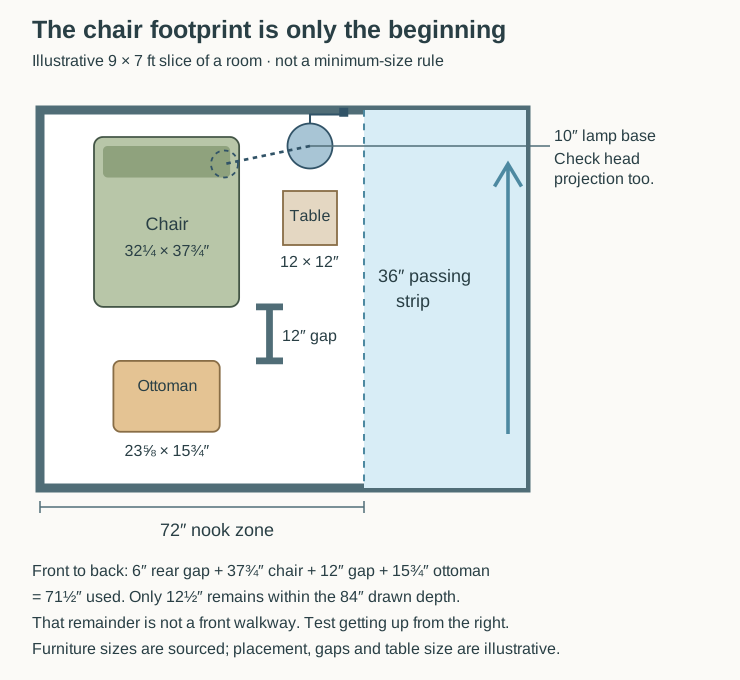
The drawing puts a 6-inch gap behind the chair. The ottoman therefore ends 71½ inches from the rear wall, leaving only 12½ inches to the bottom edge of this 84-inch-deep example. That small remainder is not an additional front walkway. Access is from the open right side, which must connect to the rest of the real room.
Try the setup with someone seated and somebody else passing. If it feels cramped, remove the footrest first or use the existing sofa. A smaller cushion does not solve a chair whose frame is too deep.
Angle the chair only if it helps
Turning a chair toward the window can improve the view, but it can also make the footprint wider. For the 32¼ × 37¾-inch rectangle above, a 45-degree turn creates a bounding square about 49½ inches across. That is wider than a 42-inch pocket even though the chair fits there when straight.
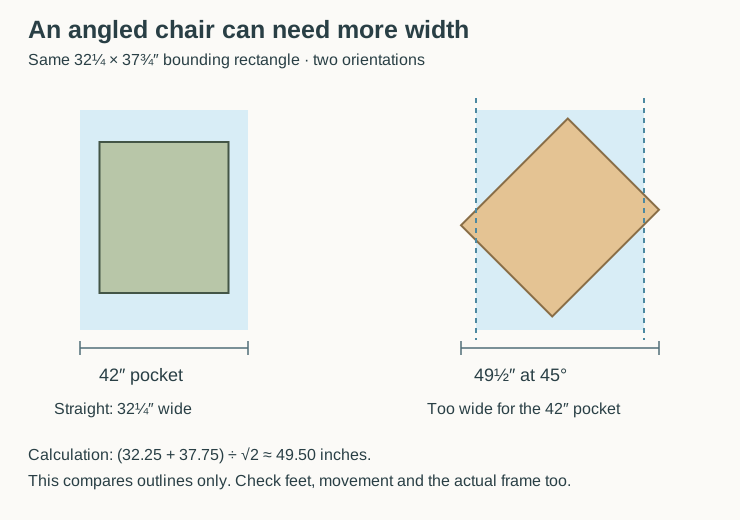
Mark the furthest corners with removable tape suitable for your floor, then try the door and walking route. If an angle consumes the side table's space, choose whether the view or the table matters more. Do not quietly move the table into the passage to make the drawing look finished.
Put light and books within useful reach
Check the light after dark as well as in daylight. From the seat, aim it at the page and check for a bright bulb in your line of sight or glare on a tablet. Test the switch without leaning awkwardly across the footrest. The small living room lighting guide covers lamp footprints and projections in more detail.
A slim lamp still has a base. For example, IKEA's LERSTA reading lamp has a 10-inch-diameter base; its adjustable head occupies additional space above it. Check the head in the position you intend to use, not just the circle on the floor.
Trace the cord all the way to the outlet. Follow the CPSC's home-safety guidance: keep cords out of foot traffic and avoid placing them under rugs or furniture or where furniture can pinch them. A nearby socket can be more valuable than the apparently perfect window position.
Give your current book, glasses and drink a stable landing place. Sit down and test the reach with an empty cup before arranging the display. Keep the rest of a large book collection elsewhere if it would require shelving over the chair or take the approach space. Secure any bookcase according to its manufacturer's instructions and CPSC anchoring guidance.
Finish with a short evening test
Use the nook for a few evenings before adding more. Notice whether the blanket stays on the seat, books collect on the floor or the lamp must move whenever somebody passes. Each tells you something specific to fix: a place for the blanket, a smaller reading pile or a different light position.
Color and a cushion can make the spot feel separate without a divider. Keep only the cushions you use comfortably. If the chair becomes a place to leave laundry, revisit its location and purpose before buying another basket.
Final Takeaway
A small reading nook works when sitting, reaching, standing and passing all work together. Start with the seat you like, test it occupied, then add light and a small landing place. Leave the extra chair or footrest out if the room works better without it.
Set your room, doors and windows, add a TV, sectional, fireplace, piano or dining table, and check the walking route before you move anything.
Main Sources
- Alexandra Gater: Empty Corner Turned Cozy Reading Nook Makeover! — credited visual example.
- IKEA specifications for the STRANDMON chair, storage ottoman and LERSTA lamp — product footprints, not occupied-space requirements.
- CPSC: Home Safety Checklist and Anchor It — cord routing and furniture anchoring.
Checked November 11, 2026. Illustrative dimensions and calculations are independent of the video. Product specifications should be rechecked for the exact model before buying.